Tag Archives: #whenwordscollide

Historical fiction: how accurate do you need to be?

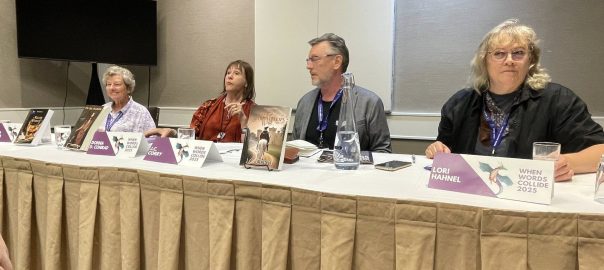
At this year’s When Words Collide Festival for Readers and Writers, https://www.whenwordscollide.org/ I participated in a panel titled Historical Fact and Fiction: what can and can’t be changed. Moderator Lori Hahnel began by asking how and where to find accurate historical facts. My fellow panelists, John Corry and Donna D. Conrad, talked of the challenges of historical research for novels set centuries ago. John’s novel about British author Geoffrey Chaucer takes place in the 1300s; Donna’s retelling of the story of Mary Magdalene in the first century. 

Donna said she used sources from different countries and religious perspectives to get the most accurate spin on Mary Magdalene. John noted that he had to be careful about dates in his research, since most countries changed from the Julian to the Gregorian calendar after his novel’s time period. 

My historical novel, A Killer Whisky, set in 1918 during World War One, felt modern in comparison, and I had more research tools available. While I found that reading historical fiction and non-fiction was useful, I learned the most from material published at the time of my novel. I signed up for a one-week free subscription to Newspapers.com and devoured the headlines of the day as well as ads for groceries, houses, jobs, and more. Online, I combed through the 1,000+ page 1918 Sears catalogue for images and descriptions of fashion and other consumer goods. Novels and memoirs published in the early twentieth century provided details of daily life, attitudes of the times, and words and expressions used. To avoid language anachronism, I suggested that the panel audience check out Google Ngram Viewer https://books.google.com/ngrams/. You plug in a word or phrase and a graph tracks its usage in books from 1800 to 2022. For instance, the word “groovy” barely registered before 1960, when it peaked. Then it dropped and hit a higher peak this century, perhaps from people writing about the swinging sixties. My WWI characters would never say “groovy.” 

Unless I try my hand at writing alternate history. 

Lori asked what we thought of television shows like Bridgerton, a Netflix series based on Julia Quinn’s novels set in early 19th century London. Main characters include wealthy and aristocratic people of colour who are totally accepted in high society. 

I said I liked Bridgerton. Everyone watching knows the world wasn’t like that then or even now, but Bridgerton makes you think, what if this alternate world were true? Donna said she enjoys these kinds of shows but cringes at the historical inaccuracy. 

Lori brought up her second concern about historical fiction: the abundance of WWII novels. Is the market saturated? Will people ever get tired of reading about that war?

John and Donna thought the trend would continue because writers are constantly finding new angles about the war. I suggested that WWII endures because it is arguably the last heroic war and it is still close to many of us whose parents or grandparents fought in or lived through the war. Perhaps, interest will wane for the next generations, until writers rediscover and reinterpret that momentous time.    

As to the panel topic question: what can and can’t be changed? We all agreed you can’t change major known facts. I wouldn’t change key dates about WWI, even though it would probably work better for my novel-in-progress if the war had started a month earlier. John and Donna said they wouldn’t change dates that Chaucer or Mary Magdalene were known to be in particular locations. 

I pointed out that Chaucer and Mary were their novels’ main characters, but it might be okay for me to write a novel set in 14th century York and have Chaucer make a cameo appearance despite no evidence that he’d ever gone there. Small changes like that wouldn’t significantly impact history or my main characters and themes, although I think it’s more interesting to readers if the historical figure really was present. We all like to pick up factual trivia from our reading and history is ripe with interesting tidbits. 

My historical novel-in-progress begins in Karlovy Vary (aka Karlsbad), a spa town in Czechia (aka Czech Republic). Somewhere I read that Sigmund Freud, founder of psychoanalysis was in Karlovy Vary at the outbreak of World War One, when my novel takes place. Unfortunately, I’ve lost the reference. (Advice to historical fiction writers: keep your references). The Psychiatric Times confirms that Freud visited Karlsbad more than once for health reasons and I’ll do my best to find my missing reference. But if I can’t, would it be wrong to make him a character in my novel? Freud’s interactions with my fictional characters would be interesting and relevant to the story. 
Home Sweet Homicide – but please don’t try this in your own home

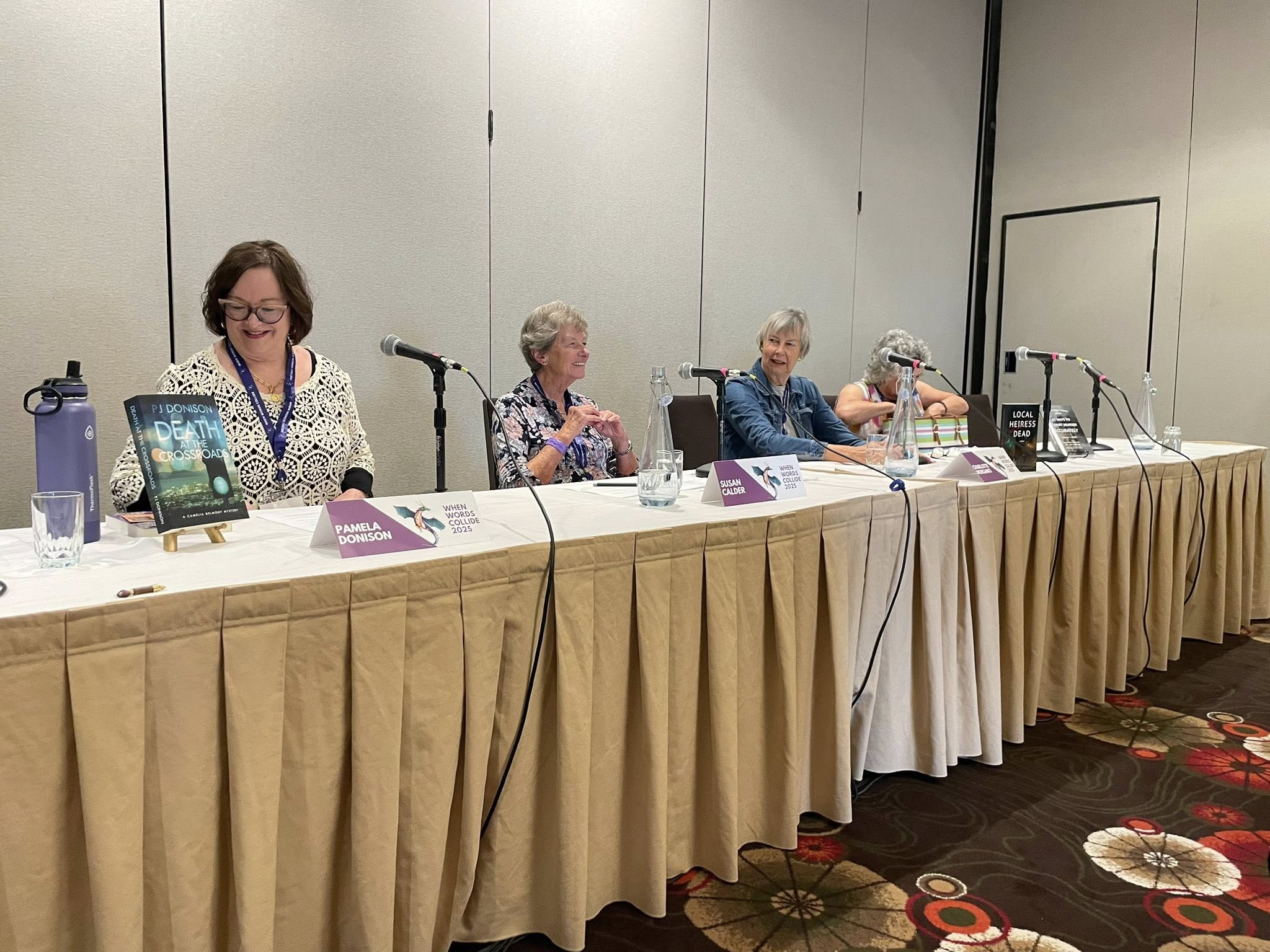
In August, at Calgary’s annual When Words Collide Festival for writers and readers I sat on a panel titled Home Sweet Homicide: the multitude of ways victims die at or near their homes. The moderator asked us panelists to describe the various methods we’d used in our mystery novels and why we’d chosen those approaches. 

I talked about my Paula Savard Mystery Series set in Calgary. Paula, my sleuth, is an insurance adjuster whose work gets her involved in crimes. In books # 2 and 3 of the series, Paula investigates a building fire and a hit-and-run collision near a victim’s home. She comes to suspect both apparent accidents were coverups for murder. Book # 4 begins with Paula investigating a theft from a bicycle store during the COVID-19 pandemic. A murder takes place in the adjacent furniture store, which has closed for the pandemic and become the home of a squatter. The victim is bashed on the head with a weapon of opportunity: a candlestick from the store’s dining room display. 

Home Sweet Homicide panel at WWC 2025

The panel’s most engaging questions related to the allure of poisons and medications thanks to our expert panelist, Lee-Anne Hancock, a retired nurse who worked at the BC Drug and Poison Information Centre. Lee-Anne told us about ordinary plants and medicines that can kill if used incorrectly — or correctly from a killer’s perspective. She noted that poisoning has been called the female murderer’s method of choice, perhaps because it is less messy and violent and doesn’t require physical strength.

As a mystery writer, I’m intrigued by the medicinal method that can easily be disguised as an accident. In two of my short stories, someone kills a relative by administering an overdose of their prescribed medicine. Even if suspicions arise and victims are autopsied, it would be normal for traces of their own medicines to show up in their bloodstreams. 

In my novel, A Killer Whisky, set in 1918 Calgary, a man dies in his living room after drinking a glass of whisky. His symptoms are consistent with the “Spanish Flu” that has struck the city and the attending doctor diagnoses the flu as the cause of death. But the man’s neighbour, who is the doctor’s receptionist, suspects someone laced the whisky with a poison or a medicine that reacted with the alcohol to produce a toxic brew. She convinces a sympathetic police detective to investigate.       

The Home Sweet Homicide panel took a light hearted approach that entertained the audience at the end of a busy festival day. Afterward, I pondered why I’ve tended to kill off my novel victims in their homes or on nearby streets rather than farther away. I came up with three thoughts. 

1. My killers and victims always know each other, which is most common with real life murders, and relatives and friends often hang out together at or near their homes.  

2. Homes are, by definition, private rather than public. There will likely be fewer potential witnesses to a crime and perhaps no witnesses. Any friends or relatives present might lie or conceal information to protect themselves, someone else, or the victim.  

3. Home is supposed to be our safe place. A home break-in feels like a violation, and a killing in our home or neighbourhood threatens our sense of security.  

My WWC 2025 panel: Home Sweet Homicide

On today’s BWL author insider blog, I talk about part of my experience at Calgary’s annual When Words Collide Festival for Writers and Readers. https://bwlauthors.blogspot.com/

WWC is a great three-day event for writers and readers of all genres of fictions. I’ve attended the festival every year since it began in 2011 and love the energy, information, networking, and more. For information about WWC 2026, check out the Alexandra Writers’ Centre Society website. https://www.alexandrawriters.org/

Mastering the Macabre

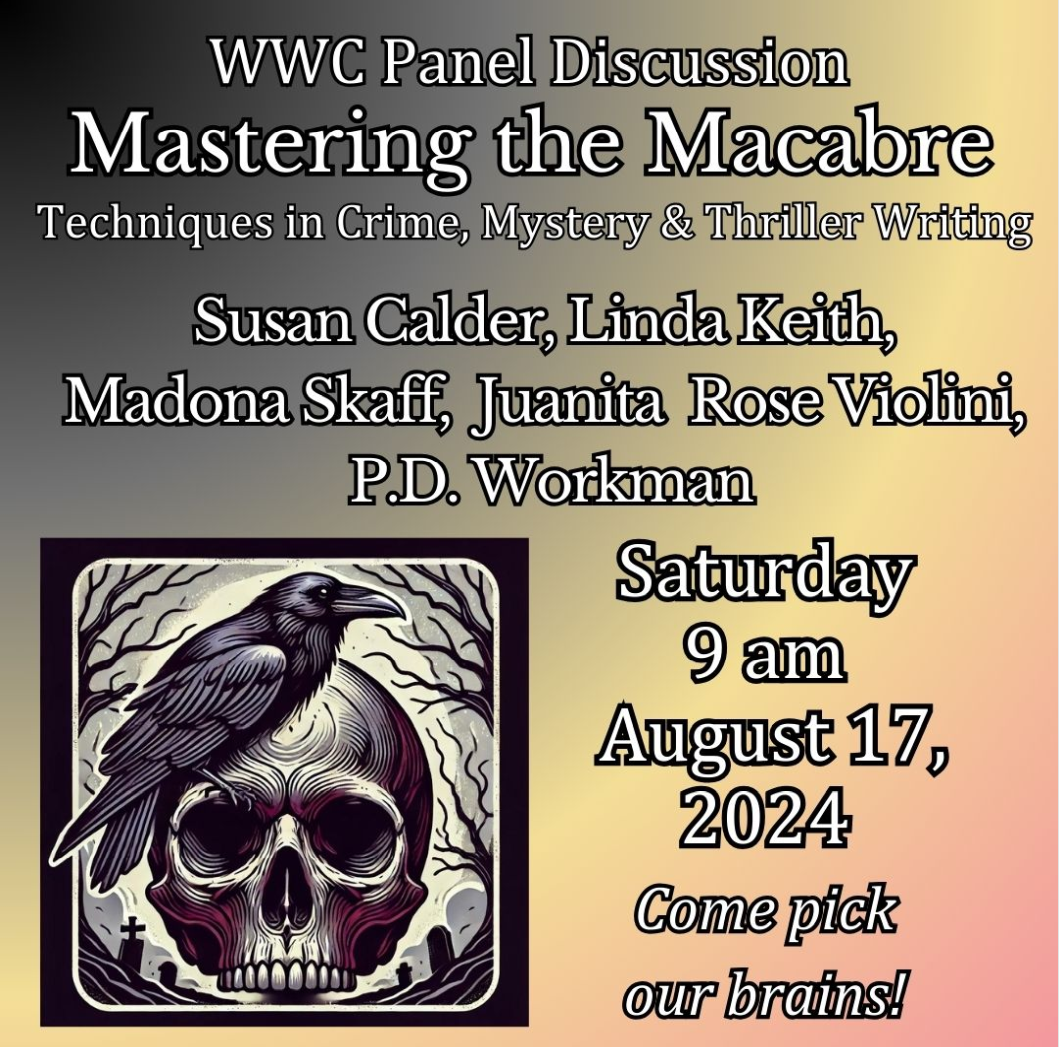
At Calgary’s When Words Collide Festival for Writers and Readers this weekend, I’ll be moderating a panel titled “Mastering the Macabre: Techniques in Crime, Mystery, and Thriller Writing. The session will explore the techniques used to create heart-pounding narratives that keep readers hooked until the very end. Hear from panelists as they discuss how to craft compelling mysteries, develop intricate crime plots, and evoke suspense. Ideal for writers seeking to sharpen their skills and fans of the genre. Join us Saturday at 9:00 am for a discussion that I expect to be both enlightening and entertaining.

Panelist Juanita Rose Violini created this chilling poster:

A fun and inspiring writers’ weekend

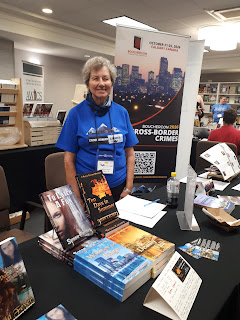
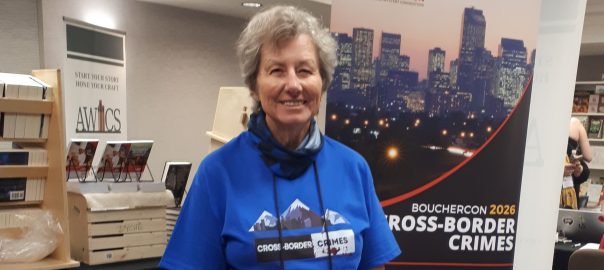
I spent the August long weekend at Calgary’s When Words Collide Festival for Readers and Writers. After three years of attending the festival online, it was great to see familiar faces in-person, make new connections, and participate in panels in front of live audiences. I also enjoyed spreading the word about BWL and Bouchercon Calgary 2026 at their Merchants’ Room tables, which were conveniently located next to each other.  

As usual I especially enjoyed WWC’s opening evening keynote addresses. The four Festival Guest Authors were each given twenty minutes to talk about anything they wanted. This year’s speeches were intensely personal and brave. Writing coach and international speaker Angela Ackerman shared her struggle with imposter syndrome despite selling almost a million books in ten languages. I’m sure every writer in the room could relate. Stacey Kondla spoke about her stroke, which prompted her successful new career as a literary agent. Nicole Baart, author of “race-to-the finish family dramas,” discussed how her need for multiple surgeries during childhood led her to becoming a writer. 

On my seven panels I discussed such topics such as creating characters, writing mental health, fiction in a world with COVID-19, putting your characters in danger, and how to write a series without losing your way (or your mind). About the latter, I confessed my method of combing through my notes and earlier series novels to recall a character’s eye colour, age, or divorce date wasn’t the most efficient way of keeping track of continuing series characters and suggested authors use a spreadsheet. Fellow panelist Cathy Ace prefers a series bible, which she described as a word document that she searches for a character’s pertinent details. Whatever works for each writer. 

At the keynote event, WWC chair Randy McCharles passed the torch (a dragon statue) to the festival’s new management, the Alexandra Writers’ Centre Society. The AWCS was busy taking registrations for next year’s festival in the Merchants’ Room. WWC 2024 is already 70 % sold out. AWCS has put together an interesting lineup of Guests of Honour and Special Guest authors. Check their website for updates and to register for When Words Collide Volume Two: Every Chapter Has Another Great Story.

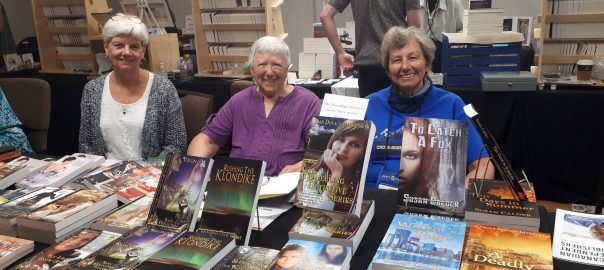
Thanks to Diane Bator (above) for organizing the BWL table. Author Layton Park stopped by to chat with Diane and do a table shift. Diane went home with ideas for sprucing up the BWL table next year. Even the Merchants’ Room can be inspiring. 

When Words Collide Chapter One Finale

Last weekend I spent a busy three days at Calgary’s When Words Collide Festival for Readers and Writers. This was supposed to be the ending of the festival’s successful thirteen-year run, but it will continue next year under new and enthusiastic management. You can read about my experience this year on today’s BWL author insider blog. https://bwlauthors.blogspot.com/

I look forward to connecting with new and old WWC friends next year!

When Words Collide Grand Finale

I’ve attended Calgary’s When Words Collide Festival for Readers and Writers every year since it began in 2011. That was the year I published my first novel, A Deadly Fall, butI didn’t attend to promote the book. I went as a fan of one of their special guest authors Robert J. Sawyer and because a friend coaxed me into going and WWC was an inexpensive, local event. When I arrived at the host hotel, I was amazed at the festival’s energy. The founders largely came from the science fiction and fantasy community and they know how to party. While WWC included all genres, it helped to understand Star Trek references. I attended several dynamic panels and presentations and did a shift at the book sale table, where I met some interesting people and sold copies of my new novel. 


The following year, I volunteered to lead a dialogue workshop, which had a huge turnout. Buoyed by this success, the next year I volunteered to sit on a few panels. WWC is entirely volunteer-run and presented, although the special guest authors receive expense money. The relative equality between everyone attending creates a democratic atmosphere, even though the guest authors are the stars. A highlight for me every year is the opening night’s two-hour keynote addresses, where the five or six guest authors each introduce themselves and speak on whatever topic they want. Often the speeches are funny and/or thought provoking. 

 
My involvement increased when I joined the WWC board and worked on developing panel ideas. We tried for topics that would appeal to readers of all genres and writers at every stage of the process, from learning the craft to finding a publisher to promoting their books. I met BWL publisher Jude Pittman at WWC 2017 when we chatted in the Merchants’ Room. After the festival, I sent her a query and soon became part of the BWL family.  

                                 BWL’s Nancy Bell and Jude Pittman at When Words Collide

 
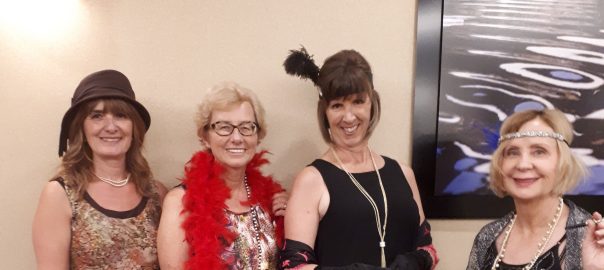
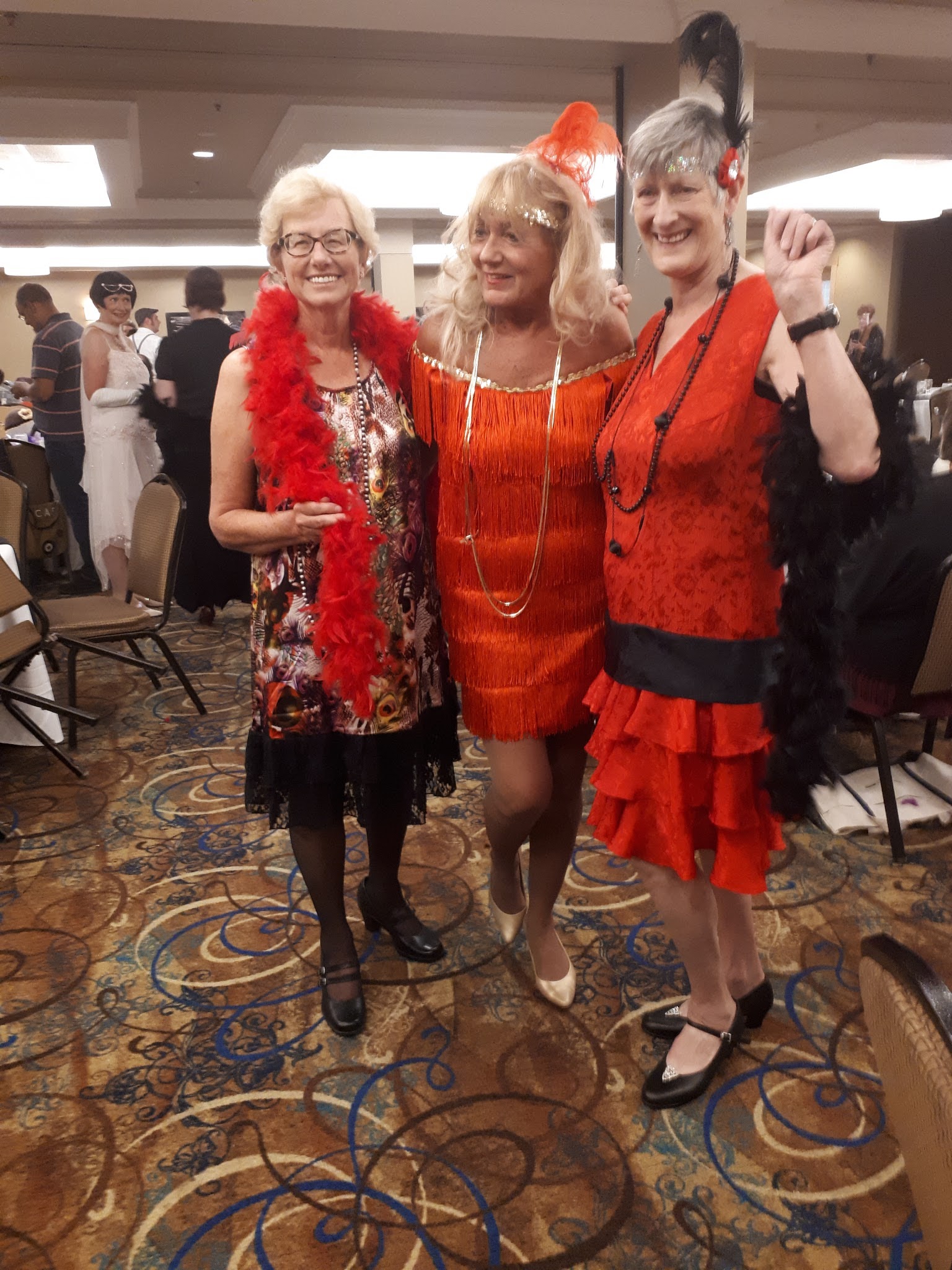
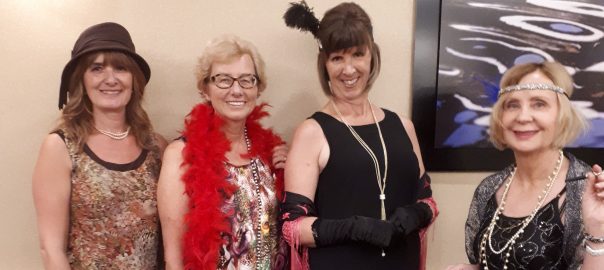
Connections also occur at WWC social gatherings. The Saturday evening banquet sells out quickly thanks to the festival’s encouragement of costumes. Here I am (left hand side) with two other ladies in red at the Roaring Twenties theme banquet.  

      Then COVID-19 hit. WWC went online in August 2020 and continued with virtual conferences the following two years. I participated in panels and attended some virtual social events, but not as many as I had previously. Staring at a computer screen wasn’t the same as meeting in person. I left the board, feeling I didn’t have the tech skills to contribute much of value. Other board members dropped off and the festival’s main organizers ran out of steam. They decided to return to the in-person festival in 2023, but this would be the final year for When Words Collide. 


Registration for WWC 2023 has reached its cap of 780 attendees, but this is due to 2020 and later registrations being carried forward to this year since the online festival was free. Spots are expected to open up, so it’s worth putting your name on the waitlist if you’re interested in attending. https://www.whenwordscollide.org/Registration/Am_I_Registered.php


I’m looking forward to the WWC finale on August 4-6 with bittersweet feelings, but this might not be a complete ending. Rumour has it another group is thinking of reviving the festival or creating something similar next year. This could give us even greater reason to celebrate When Words Collide’s wildly successful thirteen year run this summer. Hats off to you, WWC! It’s been grand. 

                                               Me with Special Guest Author Will Ferguson

When Words Collide – in person again!

Today on the BWL author blog https://bwlauthors.blogspot.com/I write about When Words Collide, Calgary’s annual festival for readers and writers, which will make its last appearance this summer. I’ll be there and plan to attend many panels and events, sit on a panel or two, and host a table for Bouchercon World Mystery Convention Calgary 2026. https://bouchercon2026.com/. Two great events for lovers of mystery writing.