Tag Archives: #CzechRepublic

My Amazing Research Trip: Day Two

Our second morning in Karlovy Vary, Czech Republic, my husband Will and I took a guided walk of the central spa zone. In my historical novel-in-progress, The Water Cure, my protagonist Marie walks this route almost every day. Much of the current landscape would be familiar to Marie. Three of the city’s main colonnades have changed little since 1914. They still shelter visitors who drink the local mineral spring water from taps flowing into old basins.  

The Mill Colonnade is a significant setting in my novel-in-progress. Our guide Barbora Volfova said that when the colonnade opened in 1881, many people disliked its classical style. I find the Mill Colonnade impressive but agree the picturesque Park Colonnade might better reflect Karlovy Vary’s predominantly baroque architecture. 

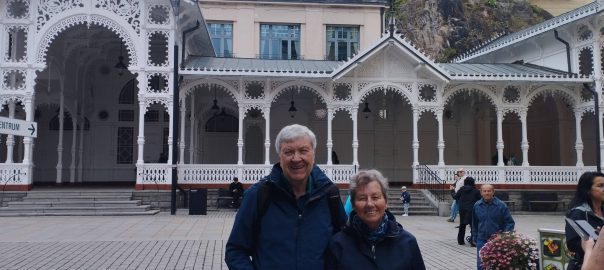
Mill Colonnade – Karlovy Vary’s largest colonnade has 129 Corinthian Columns.

The Park Colonnade:

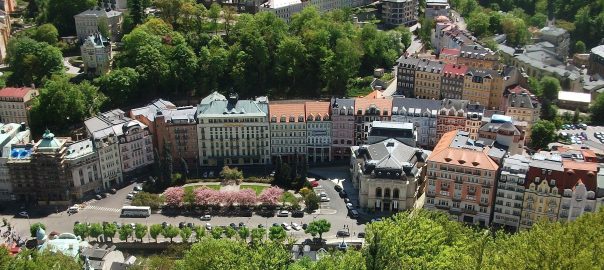
Me and Barbora Volfova in front of typical Karlovy Vary buildings.

Of the city’s five original spa buildings, the Elisabeth Spa is the only one that still offers bathing facilities to the public. Today’s visitors generally “take the cure” at one of thirty accredited spa hotels that pipe in the mineral water. In my story, Marie works at the Elisabeth Spa, and I was eager to see the inside. Before my trip, I emailed the Elisabeth Spa, explained my writing and research project, and asked if I could view their historical areas. Director Miluše Bartoňková and her assistant Kristína Jabornická generously offered Will and me a tour of the building as well as complementary traditional baths.   

My protagonist Marie gets her first view of her future workplace on her first day in Karlovy Vary. She calls it a palace. Austrian Emperor Franz Josef commissioned the spa building in the early 1900s to honour his late wife Sisi (Elisabeth). 

When Marie goes for her job interview, she glimpses the building’s opulent interior. 

Marie’s workdays as a bath attendant are spent in the spa’s bathing area. I had pictured an enormous room with sculptures and ornate decorations, individual tubs scattered throughout, men on one side of the room, women on the other, soaking in bathing costumes and sometimes chatting with their neighbours. 

It turns out people bathed in plain, private rooms along corridors. Will and I bathed nude, which I gather is the tradition. After our baths, our attendants wrapped us in sheets. We lay on table beds to let the water’s warmth seep through us.     

Miluše and Kristína took me to the basement to show me the old equipment for peat baths. These involved immersing your body in warm water infused with peat or mud. 

It all looks yukky to me, but having Marie administer peat baths would add interest to the story.  

Will and I left the Elisabeth Spa by the back entrance as Marie and the other service staff do in The Water Cure. Now I can visualize the outside lane.  

Next, we scouted lodgings for Marie within walking distance of her workplace. Will liked this building. 


I found it too large and luxurious and preferred this simpler lime green home. 

My choice will probably win, since it is my story. 

This day of research/touring provided me with many new images and details for the second draft of my novel-in-progress. The numerous changes required feel daunting, but I’m excited to enrich the story and get things as right as I possibly can.     

My Amazing Research Trip: Day One

In May, my husband Will and I travelled to Karlovy Vary, Czechia, to research my novel-in-progress, which is set in that spa city on the brink of World War One. A few months before the trip, I emailed the Karlovy Vary Municipal Library and the Karlovy Vary Museum, explained my project, and asked their advice on how to prepare for my four-day visit.    Librarian Kateřina Krieglsteinová recommended that I search the library’s online catalogue and send her a list of books that interested me so she could have them ready when I arrived. My first morning in Karlovy Vary, she presented me with a stack of twenty-one books, none of which are available to me in North America. 


Will and I poured through the books and quickly dealt with a half dozen either because we could grab the pertinent information easily or we decided the text was too dense to explore during our limited time. Most of the books were written in Czech. While my maternal grandparents immigrated to Canada from (then) Czechoslovakia after WWI, I don’t speak the language. 


Translation apps are a godsend and old photographs speak thousands of words.   

Kateřina let me take the remaining books to my hotel. Somehow, in the midst of my other research and touring, I managed to peruse them all during my next three days — who needs sleep? I took over 250 photographs of text and historical pictures that portray the city during the era of my story.  


After lunch that first day, Will and I met with historians David Čech, Jan Nedvěd, Lukáš Svoboda, and Lukáš’ dog in their office in an apartment building separate from the Karlovy Vary Museum. We spent almost two hours talking about life in Karlovy Vary (aka Karlsbad in German) during the Golden Age of the Great Spa Towns of Europe. Eleven of those towns including Karlovy Vary are now a transnational UNESCO World Heritage Site. 

 
At the end of our productive talk, I thanked the historians for giving me their time. They said it was part of their job to assist anyone interested in the town’s history. I further imposed on their generosity by leaving them a bunch of additional questions. Since my return home, David has sent me detailed replies that will make my story more authentic. 


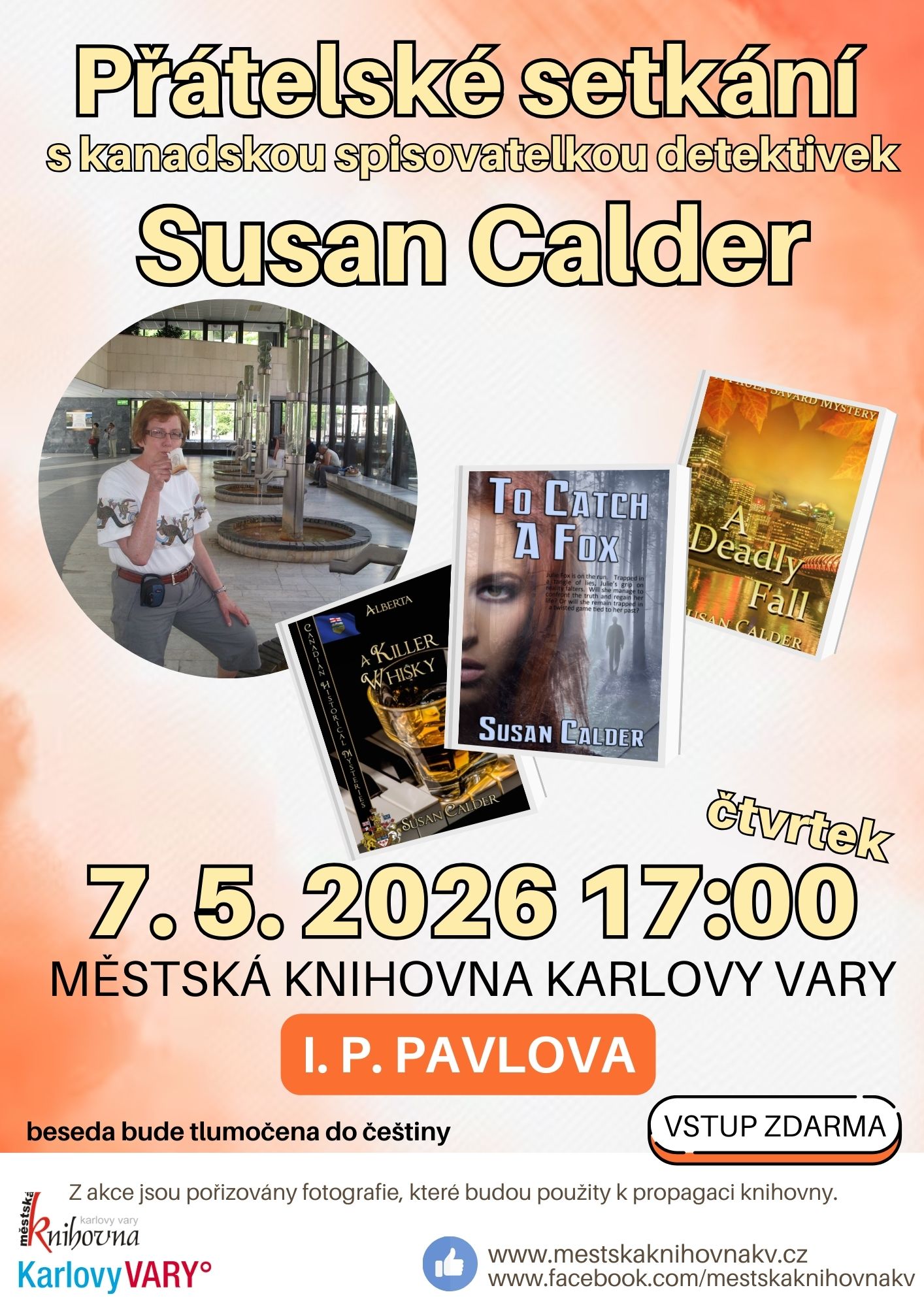
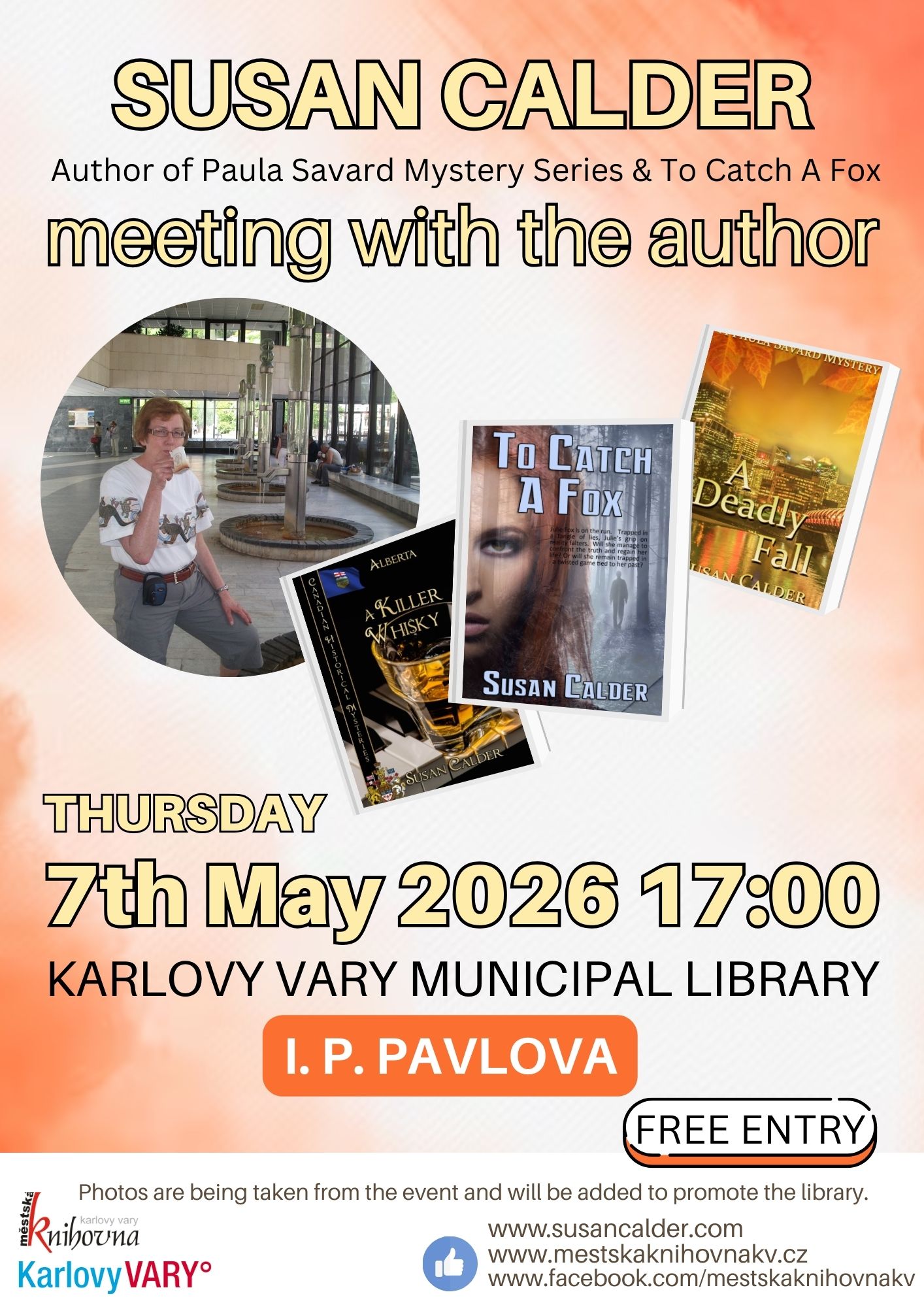
Next, we checked into our spa hotel and scurried back to the library in pouring rain for my 5:00 pm informal talk with library readers. Kateřina had arranged for a translator and created posters in Czech and English to promote the event. 

We agreed on a question-and-answer format. Kateřina posed questions, the translator restated them in English, I replied, and the translator repeated my answers in Czech for Kateřina and the audience. I’m afraid I made the translator’s job difficult by rambling on rather than pausing in the middle of my answers. Being translated is an acquired skill.    

 
To my surprise, Kateřina had purchased two of my novels online for the library. I donated a third book, and now my novels live overseas in the Karlovy Vary Library. One attendee had already read my latest novel, A Killer Whisky, and had purchased one of my earlier books, which she asked me to sign. 


I was also surprised to learn that the Karlovy Vary library is administered by the city’s Tourism Information Centre. Kateřina told the tourism director about my project, and he invited me to his office for coffee. He explained that their main markets for long-term spa visits are Czechs, Germans, and Russians living in Germany. When my novel is published, he would like to arrange for a Czech translation to encourage interest in longer stays. Would I be open to this? 


Wow! I’d assumed I was writing this book for my usual English-speaking-largely-Canadian readers.  Translation would extend its reach. I said I’d do my best to make this happen.  

You can read the Karlovy Vary Library’s write-up about my event in English thanks to their translation pop-up feature. https://mestskaknihovnakv.cz/cs/aktuality/v-pujcovne-pro-dospele-jsme-se-setkali-s-kanadskou-spisovatelkou-susan-calder